
Former Samsung engineers raise $68 mil. for force-control humanoid technology
2026.06.08조회수 119
WIRobotics, founded by two Samsung veterans, raised $68 million and won Nvidia's only humanoid fellowship on a bet the industry keeps ignoring.
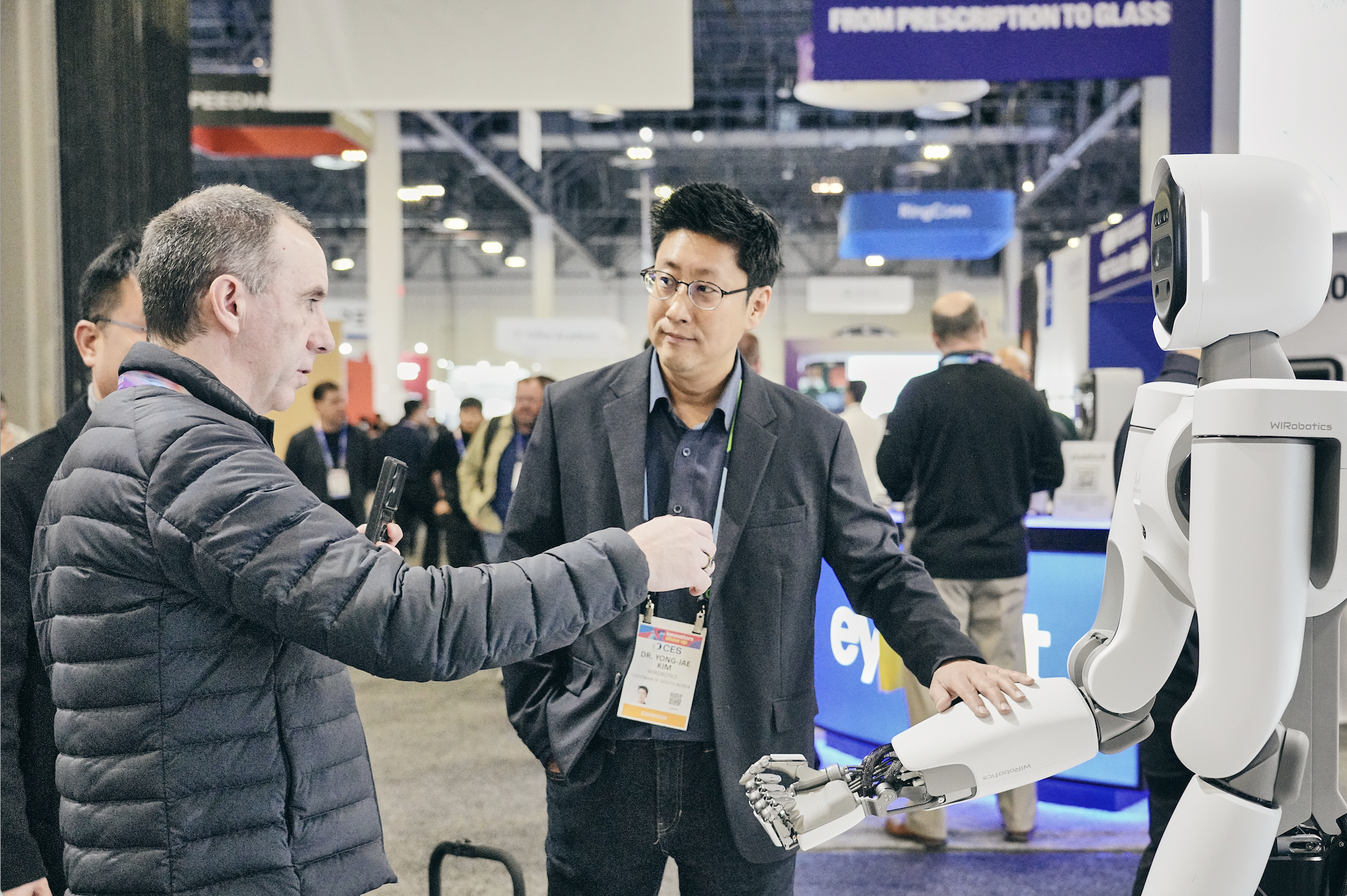 WIRobotics co-founder and CTO Kim Yong-jae at CES 2026 in Las Vegas, where ALLEX drew interest from Nvidia, Meta and Amazon. (Courtesy of WIRobotics)
The question Kim Yong-jae asks about robots is not whether they can walk. The question is whether a robot knows how hard it is gripping.
With existing industrial arms, Kim says, a robot assigned to pick up and set down soda cans cannot monitor the pressure in its own grip. The arm completes the task again and again, the way actual work requires, until something gives.
"If you keep doing it," he said, "the cans eventually burst."
Kim and Lee Youn-baek joined Samsung Electronics in the same entering class in 2003. For years they built surgical systems, humanoid prototypes and collaborative arms.
They co-founded WIRobotics, short for We Innovate Robotics, in 2021, Kim to oversee its commercial and data operations, Lee to lead its humanoid development and technology direction.
The flaw, they had concluded, was not the technology itself.
"The biggest problem we experienced at Samsung," Lee said in an interview with Korea Biomedical Review, "was the gap between a technically good robot and one the market actually chooses. Making a robot that users actually pay for and use every day is an entirely different problem."
Lee spent more than eight of his Samsung years as a principal researcher at Samsung Advanced Institute of Technology (SAIT), the company’s long-term research division, before moving to Samsung Research. He left in 2021.
Last month, WIRobotics closed a $68 million Series B. In March, Nvidia and Amazon Web Services (AWS) named the company to the second cohort of their Physical AI Fellowship, which provides cloud credits and direct access to Nvidia's Isaac simulation platform. Nine startups made the cohort. WIRobotics was the only humanoid company.
Every investor from the 2024 Series A returned.
The bet investors are making is that the soda can problem matters more than the walking problem, and that WIRobotics is the company actually solving it.
A wearable device before a humanoid
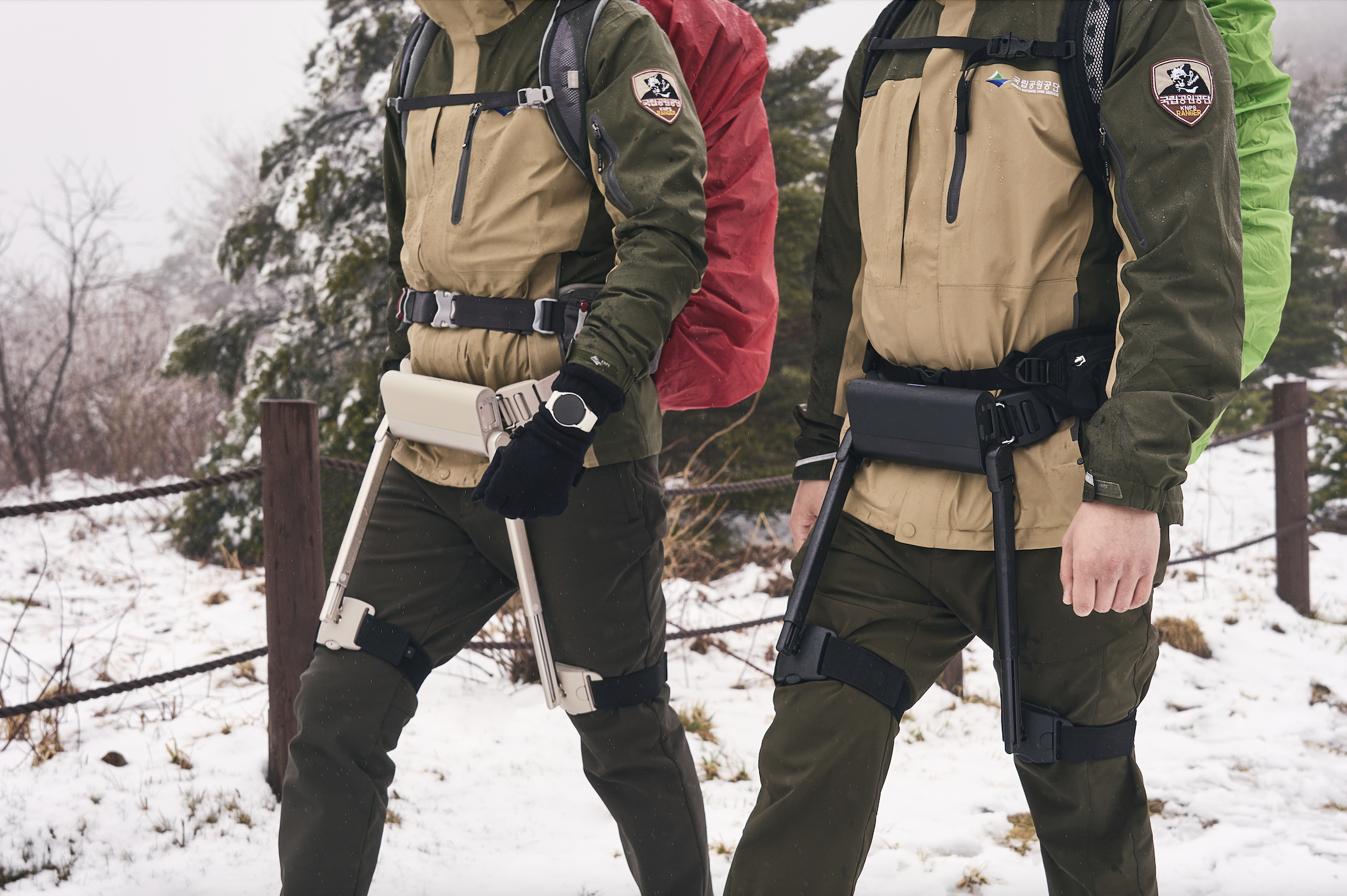 National park rangers at Jirisan wearing WIM on patrol. (Courtesy of WIRobotics)
Before ALLEX, the upper-body humanoid scheduled to begin shipping in the fourth quarter, there was WIM.
WIM clips around the thighs, reads gait in real time and applies torque to reduce the strain of walking. It weighs under a kilogram, a deliberate choice in a product category where existing devices were heavy enough that people stopped wearing them.
"We believed that if we could overcome the weight and usability limitations of existing products, we could open a personal robotics market extending beyond hospitals and laboratories into everyday life," said Kim, who left Samsung after 11 years and spent the year before founding WIRobotics as a visiting scholar at the Massachusetts Institute of Technology (MIT).
"We believe the robot market opens not from impressive demos, but from actual use experience," Lee added.
If they could build something light and useful enough that someone would choose it every day, they would know something the industry rarely tests.
Kim, who has tracked WIM's commercial rollout across Korea, Japan, China, Turkey and Europe since the product's launch, says revenue grew from roughly $400,000 in 2023 to $2 million by the end of 2025. The first quarter of 2026 alone exceeded the full-year 2024 total.
Who was buying surprised the founders. Rehabilitation hospitals and elderly patients came, as expected. So did sanitation workers, national park rangers, hikers and the mountain rescue team at Jirisan, who use WIM when extracting stranded climbers from the trail.
The company has also released a version for children ages four to 15, with a modular frame that adjusts as they grow, and won a 2026 Consumer Electronics Show (CES) Innovation Award for it.
"What appeared faster than expected," Lee said, "was workers and ordinary people who walk for long hours. They felt the value directly."
Seeking medical-device certification
WIM's next market is clinical. The device today sits in wellness, but Kim says medical-device certification is the boundary that changes everything. Once that threshold is crossed, and WIM can enter hospitals and rehabilitation centers under defined clinical protocols, ordered by physicians, reimbursed by insurers.
"Once medical-device certification is obtained," Kim said, "it can be deployed within hospitals and rehabilitation settings under defined clinical objectives and treatment protocols."
That opens a tier of applications the current product cannot reach: stroke rehabilitation, recovery-stage exercise programs, post-discharge management and remote monitoring.
"For healthcare providers," he said, "official verification of safety, efficacy, and quality-management systems is critically important."
For Lee, WIM was never only a walking device. "We continued advancing our research into humanoids," he said, "which we view as the ultimate form of interactive robotics. WIM and ALLEX are part of a single roadmap toward robots that coexist with humans."
Every unit in the field was also logging force profiles and torque patterns, the physical record of how a human body loads each stride on a real surface. For a company planning to build a humanoid with hands, that record is the training foundation.
The manipulation problem humanoids have yet to solve
The humanoid industry's central argument is that solving locomotion -- bipedal walking, dynamic balance, the increasingly convincing demos --is most of the problem. A robot that moves like a person will, the logic goes, soon work like one.
Kim rejects that premise.
"The most overhyped thing," he said, "is treating 'moving like a human' and 'working like a human' as the same thing."
Bipedal locomotion, he says, is largely solved. The harder question begins the moment a hand contacts an object. Not where the fingers are, but how hard they are pressing, and whether the robot can feel the difference.
The engineering term for what WIRobotics is pursuing is backdrivability: the capacity of a robot arm to yield to external force rather than resist it. Most industrial arms are optimized for positional accuracy. They go precisely where they are told. What they cannot do is feel.
"When a human passes a component to a robot and the arm is too rigid," Kim said, "even a small positional error causes the robot to drop it or strain the person's wrist. When backdrivability is good and force control is precise, the robot feels the person pulling and naturally cooperates."
To achieve this, WIRobotics built its own actuators rather than using the harmonic drives most robot arms depend on. The custom components carry roughly one-twenty-fourth the rotational inertia and one-eleventh the friction of standard parts.
ALLEX is built around this distinction. Kim, who also holds an associate professorship at the Korea University of Technology and Education (KOREATECH) since 2014, unveiled the robot on his own campus, at the university's Robot Innovation Hub.
ALLEX's hand has fifteen degrees of freedom and weighs about 700 grams. It can detect forces as fine as 100 grams without any external sensor, through proprioceptive feedback alone. Fingertip repeatability is below 0.3 millimeters. The full arm, shoulder to fingertip, weighs five kilograms.
"Where existing collaborative robots excelled at stopping safely," Kim said, "what ALLEX pursues is interacting safely."
A robot that stops when it senses resistance cannot actually work next to a person.
"Humanoid safety cannot be solved by a single sensor or an emergency stop button," Kim said. "The robot's mechanism itself must be designed to work alongside people."
For Lee, the goal is simpler.
"Not a robot that looks like a person," he said, "but a robot that can learn human work in actual field conditions."
Competing on capability, not cost
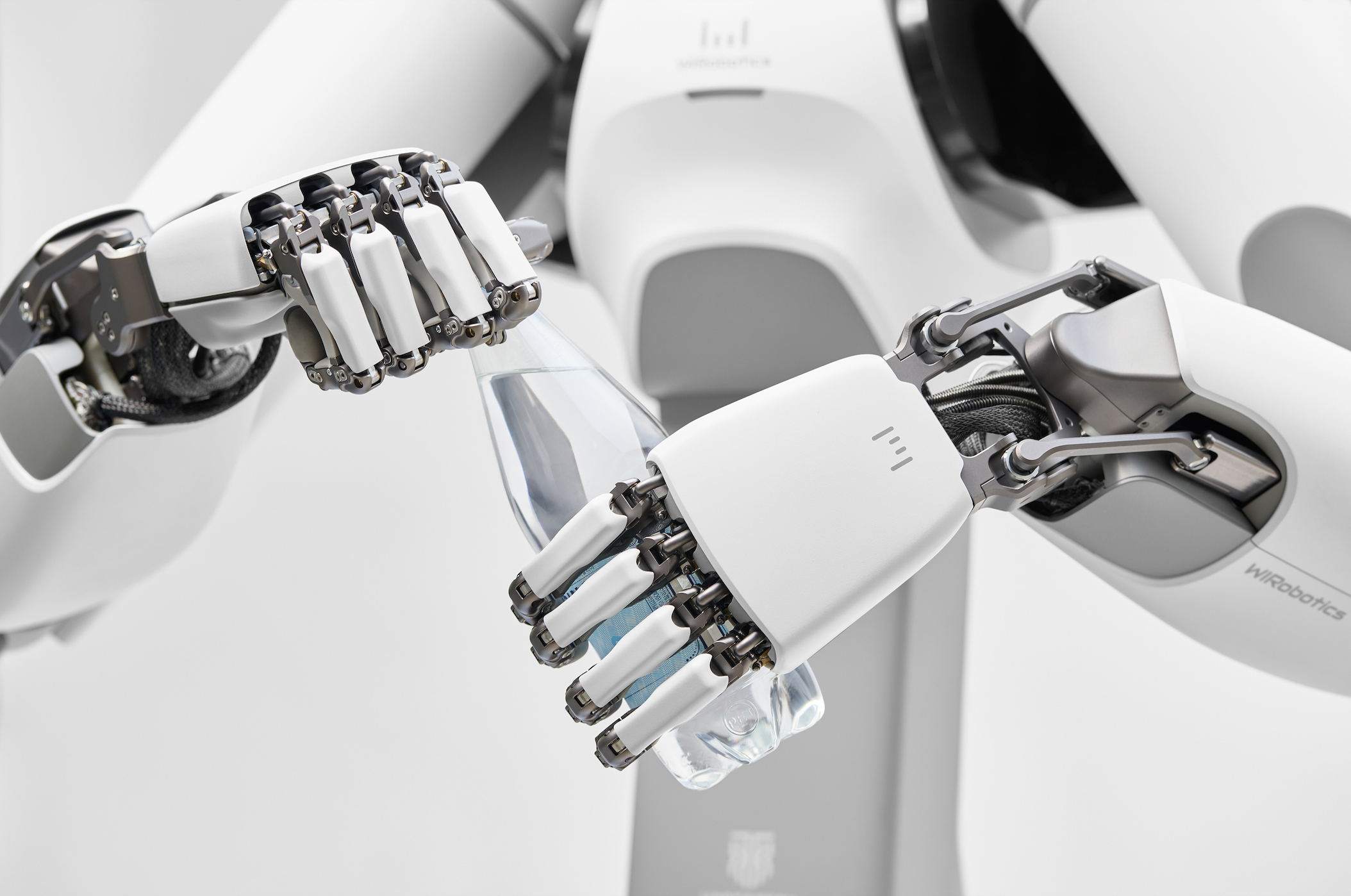 ALLEX holding a bottle. (Courtesy of WIRobotics)
The $68 million round, led by JB Investment and joined by eight other firms, closed May 14.
"There were two things investors valued most," Lee said. "First, the technology: precise manipulation and safe force control, the core bottleneck in humanoid robotics. Second, the track record of having actually commercialized a consumer wearable robot and built a market around it."
Many humanoid companies have raised capital on demos. WIRobotics raised it on 3,000 units sold and a revenue line that more than tripled between 2023 and 2025.
The competition the company is most deliberately not entering is on price. Unitree and Fourier Intelligence have reached production volumes and price points no Korean startup can match at scale.
"Competing on volume or price with Chinese manufacturers is not a realistic strategy for Korean companies," Kim said. "The edge has to come from high-precision manipulation, safe physical interaction and the engineering capability to solve hard problems alongside customers in the field."
Korea's manufacturing base gives WIRobotics a particular set of test grounds: Hyundai's assembly plant in Ulsan, Kia's in Gwangmyeong, battery production lines in Cheongju and Pohang. Proof-of-concept (PoC) discussions with global automotive manufacturers are underway. Full production line deployments are planned for 2027, once a wheeled version of ALLEX ships at the end of next year.
ALLEX's first customers will not be factories. They will be AI companies and research institutions that need a platform for collecting manipulation data and training models on physical interaction, organizations for whom the value is not a robot doing the job, but a robot learning how.
"Parts of the current market are overheated, that's true," Kim said. "But I do not see this as a simple fad. The biggest difference from the past is that AI is beginning to expand beyond the digital world into the physical world."
출처 : KBR Kim Ji-hye